Who Decides What You’re Called?
Two people can cross borders for the same reason, but walk into completely different identities. Hmm, what a bizarre linguistic magic!
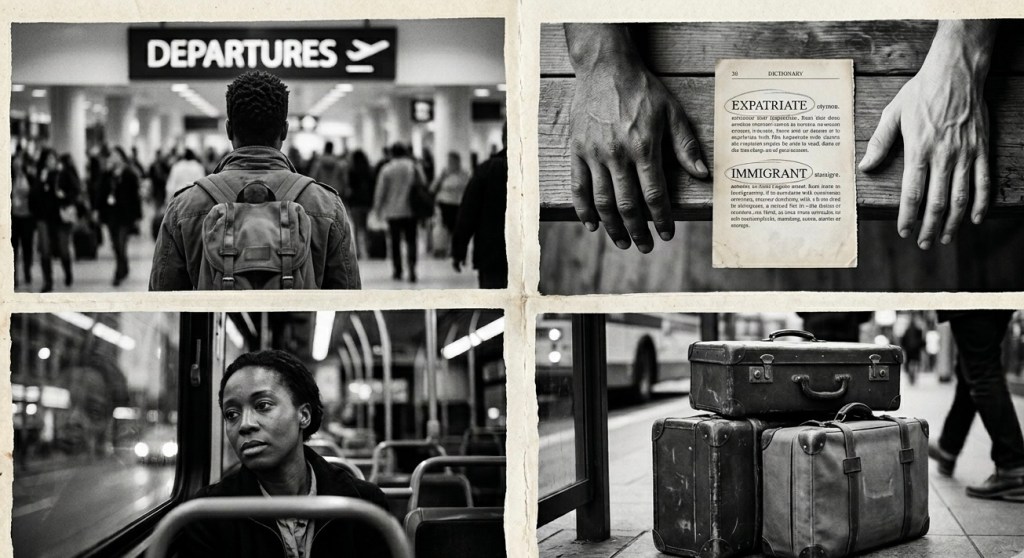
If I didn’t define myself, I would be crunched into other people’s fantasies for me and eaten alive. — Audre Lorde
This thought often crosses my mind. How is it that a person from the West moves to the global south for work and is called an expatriate? Meanwhile, a person from the global south can move to the West for the exact same reason, but is called an immigrant. It’s the same physical action. But the story we tell about that action is worlds apart. And somewhere in that difference, a whole identity is assigned.
Technically, the dictionary doesn’t see the fuss. Expatriate comes from Latin, meaning to live outside your native country. An immigrant is someone who has moved to another country. It’s obviously a tie. But in reality, one feels like a breezy summer invitation. The other feels like a legal deposition.
Yeah, it’s just a label, I hear you. But labels are not silent; they’re busy doing work behind our backs.
The word expatriate feels like someone who is exploring or contributing, someone who is just passing through but welcomed while they’re there. The word immigrant? Oh, now that feels like scrutiny. It’s as if you’ve arrived with a debt; suddenly, you have something to prove.
Maybe I’m overthinking it. But I don’t think that’s the case. I mean, we don’t just use words to describe reality. We also use them to rank and position people. But I guess you already know that. If that’s true, then these are not just labels; they shape who gets a seat at the table and who gets the benefit of the doubt. With time, the ripple effects spread through society, shaping how policies are made, who feels they belong, and what opportunities are made available or withheld. This happens before you’ve even spoken. Before anyone knows your story. Before your skills, education, or reasons are considered, you’ve already been put into a box.
What bothers me is how invisible this process is. Two people arrive with the same qualifications, intentions, and work ethic. But one is seen as bringing value, while the other is being auditioned and judged to see if they have any value. All because of what the label suggests.
Look how we call a British retiree in Lagos an expat even if they plan to stay there for the rest of their lives. Under the same breath, we call someone from the global south living in Dublin an immigrant, even if they contribute tremendously to the economy and travel back home every summer and every Christmas for 8 weeks. The label itself is a sociolinguistic bias, and it really has nothing to do with how long you stay or what you contribute.
And this difference in labels goes further, it doesn’t end there. It follows you into your career.
You can show up with a Degree, a Masters or a PhD. You have years of training, experience, and a resume that has earned its keep. And you’re still told it doesn’t count. You’re asked to re-train, re-qualify, and basically hit the reset button on your entire adult life. If you can’t afford the time or money to prove you know what you already know, you take whatever work is available. Before you know it, your story changes. You’re not a specialist or someone with qualifications anymore; you become the person doing a job that doesn’t reflect your mind, experiences, effort, or intellect.
It’s what this does to a person’s mental health that gets to me too. Let’s not even go into the financial hit; that part is real and obvious. I’m talking about the constant exhaustion of having your competence questioned, your experiences dismissed, and having to explain yourself in places where others are simply accepted.
Think about the reverse situation for a minute. A Westerner moves to an African country, sometimes with fewer qualifications, and is often met with immediate trust. They’re seen as capable until proven otherwise. For the immigrant, the default setting is “incompetent until proven capable.” As it is, you’re not just carrying your skills; you’re carrying the burden of having to justify them every single day.
That contrast is hard to ignore. I don’t think it’s just about systems or policies, but the assumptions about where value comes from; who is seen as already competent, and who has to earn that recognition. Still with me?
Of course, there are reasons for these systems, like standards and regulations. Not all qualifications can transfer easily between countries, and that’s understandable enough. But the experience feels biased. There’s a difference between verifying someone’s competence and assuming they’re incompetent until they prove otherwise.
Tell me, when you meet someone new, especially someone who has crossed borders, what label comes to your mind first? Does it assume value, or require a receipt? What would happen if you ignore the label and met the person without the label? Even small changes in language or perspective can challenge the way these assumptions shape people’s lives.
Let’s think about this seriously though. What happens when someone is told, over and over again, that who they are is not good enough? How should they respond to that? Do they shrink and start changing themselves to fit? Do they explain themselves more and try to overcompensate? Do they let go of parts of themselves just to survive the scrutiny? Or do they carry this silently, trying not to let it define them? At some point, this stops being about migration. It becomes about identity, the roles people are pushed into, and the ones they have to fight to reclaim.
More than geography or passports, it also seems tied to history and power: who gets to decides whether someone’s presence is a contribution or an asset, and someone else’s presence is automatically a burden. Somehow, all of that is compressed into a single word: expatriate or immigrant.
I’m not sure what the perfect label is, or if we even need one. Maybe that’s not the point. But I’d like to ask: Who are you before the world gave you a label?
How much of your current identity is actually yours? How much of it is the result of a label you’ve been forced to live up to or live down? I invite you to reflect on the labels (big or small) you’ve carried and what they’ve meant to you? Perhaps we all have our own stories about the power of a label.
Discover more from Aleye Boyle
Subscribe to get the latest posts sent to your email.


Thoughts? I’d love to hear them.