I’ve reached a point where questions like “Who are you?” or “Tell me about yourself” feel like pop quizzes I didn’t revise for and don’t particularly care to pass. Sure, I’ve got a script for every setting. Don’t we all? Context-appropriate scripts that keeps the wine pouring and the conversation moving.
“So, tell me about yourself.”
Hmmm…I’m never quite sure how to answer this. Ok, that’s not entirely true. When I hear those words, my brain does what it always does. It scans the room, checks the stakes, and pulls the safest version of me off the shelf. A well-rehearsed 30-second trailer. Efficient and socially acceptable.
But the real answer is not something I can package into a sentence. It’s more of an internal eye-roll and a silent, “Ugh…which version of me do you want?” The one with coffee? The one without? The productive one? The slightly unhinged one staring at the wall, wondering whether her personality is actually just a collection of habits she learned to survive? My answer changes depending on context, who’s asking and why. Sometimes it also depends on whether I feel like explaining myself in ways that make me easy to digest. And I wonder, is this me? Or is this just the most efficient version I’ve rehearsed? Sometimes I don’t even like the version answering. There’s something disconcerting about recognising how automatic you’ve become.
Alice in Wonderland keeps coming to mind. When the Caterpillar asks her who she is, she doesn’t reach for credentials, or a backstory. She simply admits she hardly knows. That she’s changed several times since morning. Wow…that must be the most truthful answer anyone can give. Alice didn’t have a script; she just spoke her mind.
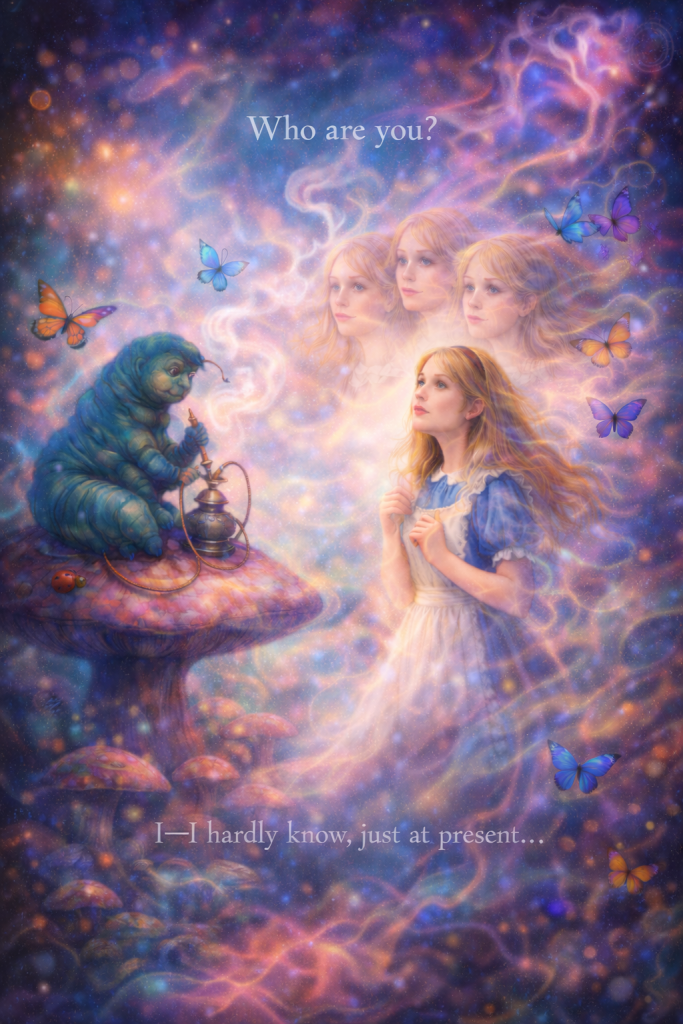
And look who’s asking – a caterpillar. A creature built for transformation. He will dissolve into something else entirely, yet he sits there like the authority on identity. Maybe that’s the joke, haha. He’s the most changeable creature around, but he expects Alice, a child, to have her whole identity figured out. How ironic! We expect everyone else to know who they are, yet we’re all mid-metamorphosis, pretending we’re finished products.
Let’s think about this for a short minute. Imagine if I tried being as honest as Alice at a networking event, or worse, a job interview. People would probably show me the door and I’ll be swiftly escorted out of adult society. As adults, we’re expected to have a fixed identity, like a passport we carry everywhere. But deep down, I feel more like Alice, always adjusting to fit the situation, and feeling lost afterwards. Most of the time, I just want to say, “I’m not sure who I am at this very minute. I’m still figuring myself out.” Saying that out loud socially can be frightening on a normal day. It goes against every expected social script.
I wrote a book trying to untangle this question. I thought if I traced every role, every belief, every pattern, I’d eventually find something solid underneath. A core, a centre, or something fixed I can point to and say, “There, that’s me.” Instead I found more layers. Identity started to look less like a foundation. It looked more like a bracelet with beads threaded over time. Some were inherited. Some were chosen. Some were picked up because they worked once. And I kept repeating them.
The self is not something ready-made, but something in continuous formation.”
— John Dewey
We try something once and it worked well. We repeat it, it becomes familiar. Other people expect it. We expect it. And before we can say “Abracadabra” it becomes automatic and feels like who we are. After a while, we forget we ever adjusted. We forget it was situational response, and it becomes the default setting. Until one day it doesn’t fit. And instead of thinking, maybe this response has run its course, we panic. We panic and assume something is wrong. We tell ourselves we should be consistent, predictable and certain.
But what if identity is not something we discover buried deep inside us? What if it’s something we assemble through repetition? At what point does repetition turn into identity? And at what point does identity turn into obligation?
If parts of me were built in response to what worked, then what happens when it stops working? Doesn’t that mean identity is adaptive? And if it’s adaptive, then it can be revised…right?. This is both liberating and terrifying. Because it would means I can’t hide behind “that’s just who I am” forever. It also means I’m not broken when something no longer fits.
We celebrate growth when it looks like achievement. New job. New title. New clarity. But what about growth that feels like unthreading? When you admit that the version of you everyone recognises is not the one you want to keep? It’s easier to say, “That’s just who I am.” But much harder to admit, “This may have been who I needed to be.”
You see, the adult world wants us to stick to one version of ourselves. It rewards us when we’re predictable and easy to understand. If you admit you’re just a mix of changing moods, memories, and ongoing thoughts, people get uncomfortable. They want a quick summary. They just want to know who you are, not an existential crisis. No boring stuff.
When someone asks, “Who are you?”
Maybe the most honest answer is not a title, a role, a label or a trait. Maybe it’s taking a moment to think, and notice the version speaking before you commit to it. Or noticing the answer you feel compelled to give. Because if identity is assembled, threaded, repeated into existence, then it’s always mid-construction. And always provisional.
I often feel a lot like Alice wandering through my own version of Wonderland. I keep acting out the identity I’m supposed to play, wearing my socially acceptable self like a coat. But maybe Alice was onto something. Maybe we’re not supposed to know who we are forever. Maybe just like Alice, you only need to notice when the version of you from this morning doesn’t match the one reading this right now.
“People tend to think they know themselves, but everyone carries around a version of themselves that they don’t fully see.”
— Toni Morrison
The Caterpillar probably had a good reason to ask his question. Wonderland kept changing Alice’s size and shape, and it affected how she felt about herself. She had been stretched, shrunk, corrected, dismissed, doubted, and redirected by everyone she met, leaving her confidence shaky. And the Caterpillar, being the master of transformation, sensed this. His question helped Alice realise that there might never be a final answer to who she is during her time in Wonderland. Perhaps that’s the point: not having a final answer is itself an answer. Our identities, like Alice’s, are always shifting. Ultimately, we’re meant to keep asking and notice how we change along the way
Who am I? Ah…I knew you’d ask.
Right now, I’m just someone thinking out loud.
Although, if I ever find a version of who I am that feels permanent, I’ll let you know. But don’t wait up. I already feel a little different than I did a few paragraphs ago. By tomorrow, or who knows, in twenty minutes, I’ll probably see things differently again.
.
Thanks a bunch for reading!
Discover more from Aleye Boyle
Subscribe to get the latest posts sent to your email.


Leave a comment